A Zero-Waste, Non-Toxic Refinery that Fits Inside a Standard Industrial Building.
Now this is sustainability.
Zero-waste,
non-toxic,
no water.
Legacy refining is toxic, slow, and expensive. Ours isn't.
Every conventional critical mineral refinery in the world is built around processes — solvent extraction, carbonyl vapor-phase refining — that require massive capital investment, years of environmental permitting, and the management of highly toxic waste streams. Those barriers are not engineering problems. They are the reason domestic refining has never been economically viable at the scale the U.S. needs. Precision Periodic's Nano Beads™ purification process was designed from the ground up to eliminate every one of them.
The Technology: Nano Beads™
inside a Multi-Scale Refining Unit.
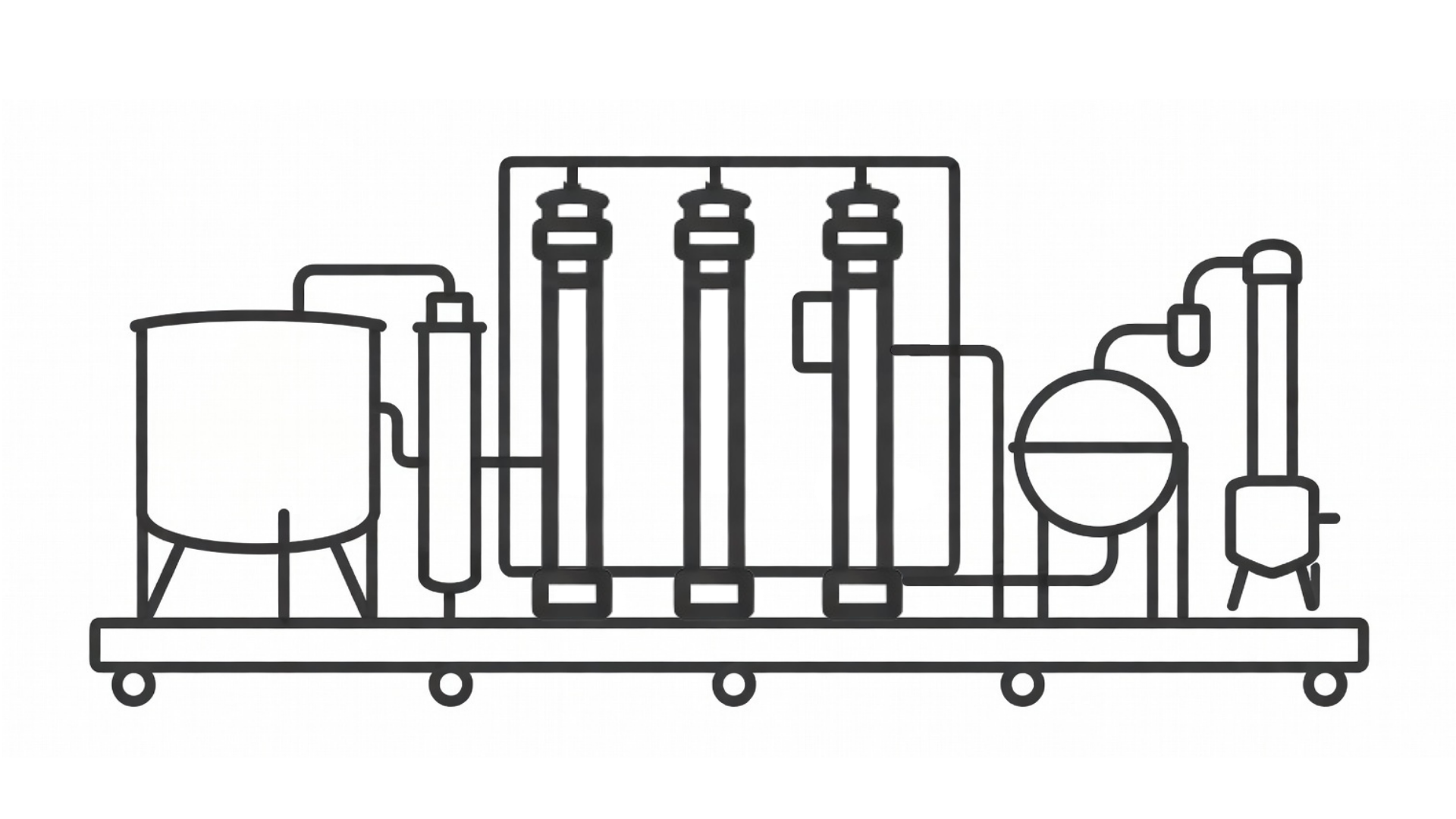
The core of the process is the Multi-Scale Refining Unit (MSRU) — a compact, skid-mounted system measuring 20 feet long by 8 feet wide. Inside it, Precision Periodic's proprietary Nano Beads™ sit in vertical column modules and do the work that toxic solvents and extreme heat do in legacy refining — selectively separating metals from a feedstock solution with precision, at low temperature, using only non-toxic commodity reagents. The same equipment refines nickel, cobalt, manganese, and lithium. No retooling. No process change. No additional permitting.
How it works. Every step.
-
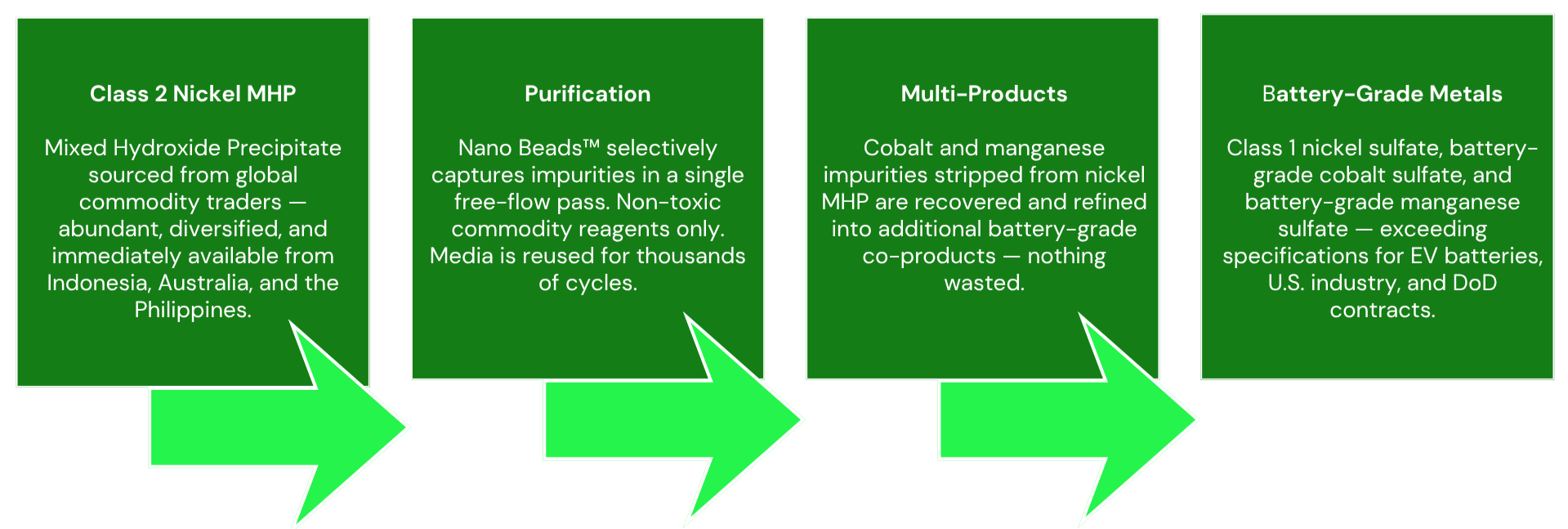
Nickel Mixed Hydroxide Precipitate (MHP), containing approximately 30% nickel by weight, is purchased on the open metals market and delivered in standard sealed one-ton super sacks. It is the starting point for everything that follows.
-
3.3 tons of nickel MHP are dissolved in an off-the-shelf leaching tank using three commodity reagents: sulfuric acid, hydrogen peroxide, and water. The result is a metal sulfate solution at pH 4. No high pressure. No extreme heat. No exotic chemistry.
-
The leach solution passes through a simple filter to remove particles above 75 microns. MHP feedstock contains virtually none, making this a straightforward pre-treatment step.
-
This is the core of the process. The filtered solution, heated to 60°C, is pumped through the Nano Beads column modules. The Nano Beads selectively exchange nickel loaded on the column for impurities present in the solution — cobalt, manganese, magnesium, zinc, copper, calcium, and sodium. The output is a battery-grade nickel sulfate solution. Purity upgrades from approximately 82.7% dissolved MHP to 99.85% NiSO₄, ICP-MS verified. Cobalt drops from 100 ppm to under 2 ppm. All other impurities are reduced to trace levels.
-
The purified nickel sulfate solution moves to a standard crystallizer to output battery-grade Class 1 nickel sulfate hexahydrate (NiSO₄·6H₂O) powder. Water is recycled and reused. The output is packaged in sealed super sacks and is ready for sale. Other product forms such as nickel oxide, nickel metals etc. can also be produced using standard conversion processes.
-
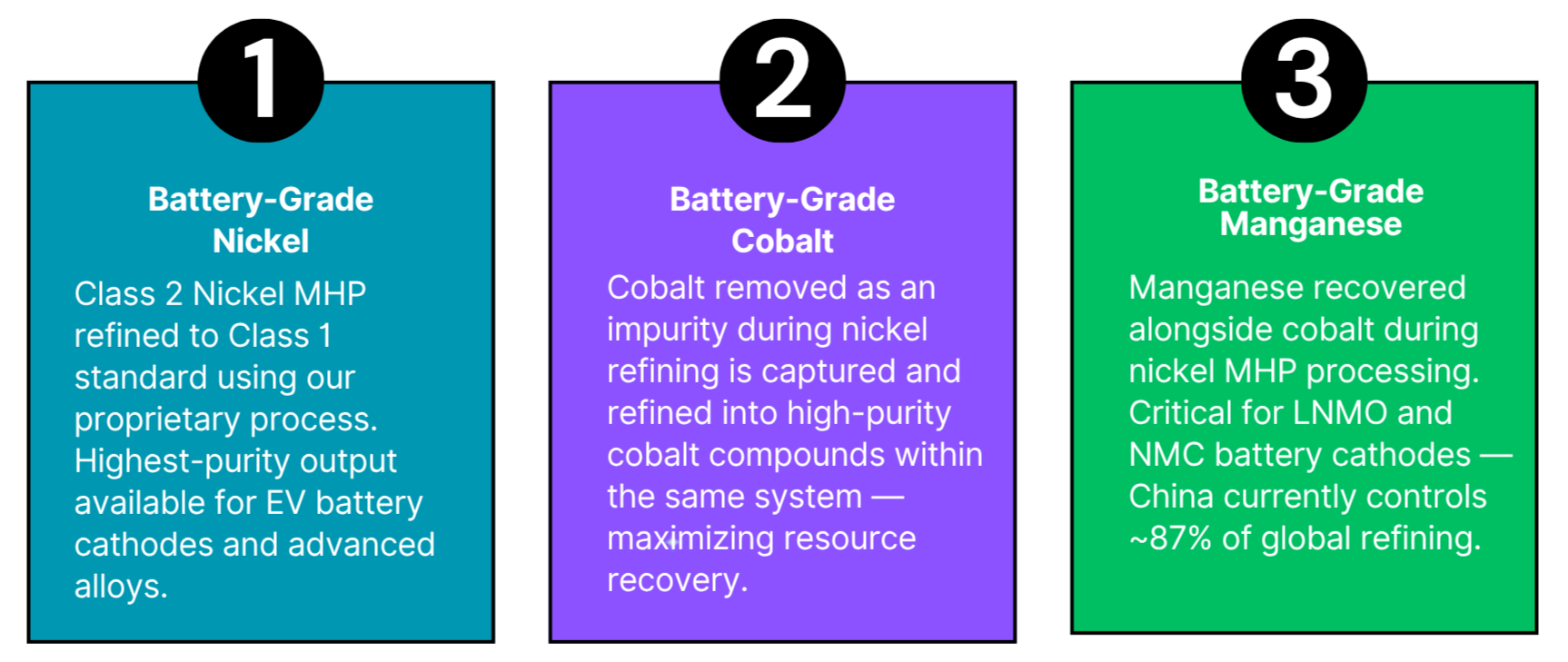
The impurities captured by the Nano Beads are not waste. They are collected, concentrated, and passed through a second identical MSRU to isolate and upgrade manganese to battery-grade MnSO₄·H₂O — a high-value second product. The remaining solution then passes through an MSRU to isolate and upgrade cobalt to battery-grade cobalt sulfate. Three saleable products. One feedstock. Nothing sent to landfill.
Every design decision in our process addresses the real barriers to domestic critical mineral production: capital, time, permitting, and environmental impact.
The highest-value step in the chain. And the one the U.S. is missing.
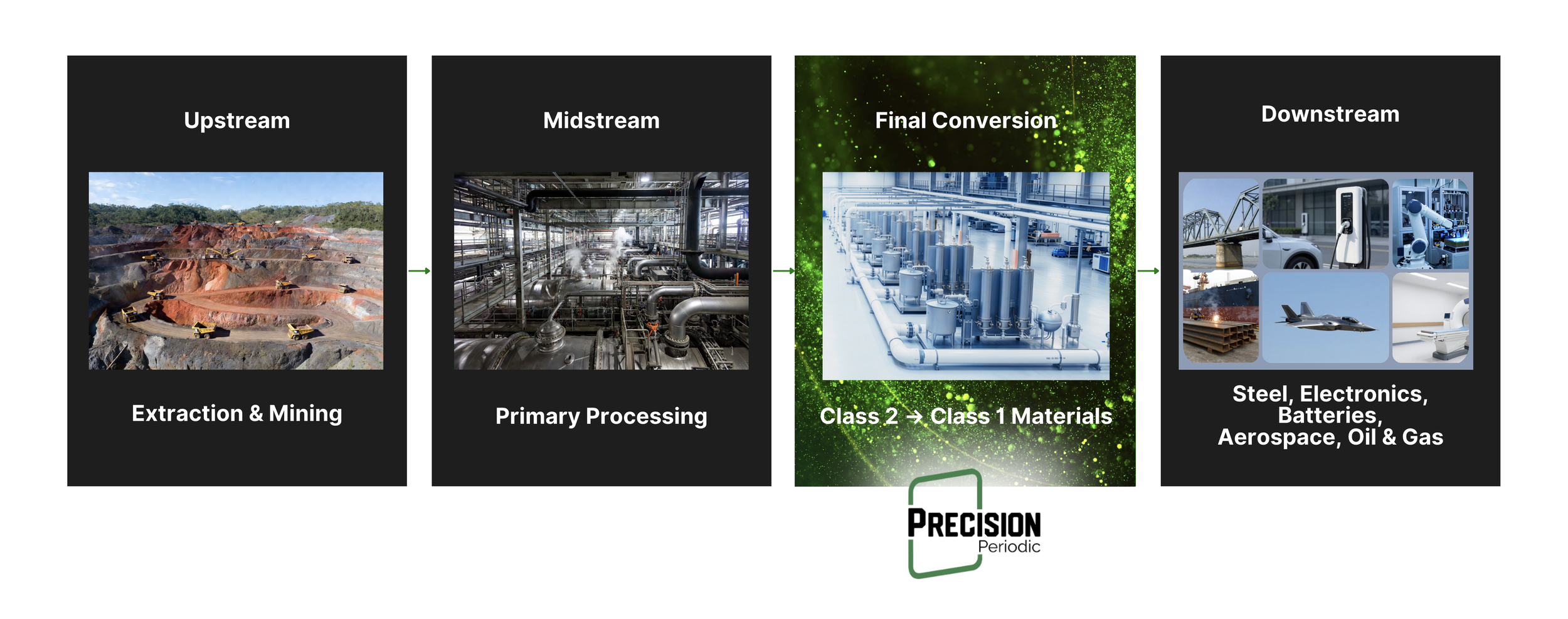
Purification is the final conversion stage in the critical minerals value chain — the step that transforms a traded intermediate product into a finished battery-grade material ready for cathode manufacturing. It is also the step at which the greatest value is added, the greatest margin is captured, and the greatest strategic control is exercised. It is the step the U.S. currently does not perform domestically at all.
The Critical Minerals Value Chain
Nothing Wasted, Everything gained.
No other refinery process can process all the valuable metals contained in a nickel MHP feedstock to battery-grade class 1 on the same equipment with the same process.
All other refining processes generate hazardous waste streams that require expensive treatment, storage, and disposal. Ours generates none.
Acid is recovered and recirculated. The Nano Beads™ media are regenerated and reused indefinitely.
Zero liquid hazardous waste. Zero solid hazardous waste. Zero toxic emissions.
Why the economics are
structurally different.
The cost advantages of the Nano Beads™ process are not marginal improvements on legacy refining — they are structural, and they flow directly from how the process is designed.
-
CAPEX runs approximately 90% lower than traditional solvent extraction or carbonyl-based refining because the process requires no purpose-built mega-facility, no high-pressure reactors, no extreme-temperature infrastructure, and no hazardous waste management systems. The MSRU is a standard skid that fits inside an existing industrial building. Multiple units fit comfortably within a standard warehouse footprint, and each unit added is incremental production capacity with no process risk.
-
OPEX runs approximately 70% lower because the process operates at low temperature (60°C), uses only non-toxic commodity reagents available on the open market, recycles all process water internally, and runs the same Nano Beads™ media across multiple metals and multiple cycles without replacement. Each MSRU produces 4.48 tonnes of battery-grade nickel sulfate hexahydrate per ton of nickel input, processing 42 kg of contained nickel per hour. At 27 units, that is 44,800 tons per year of battery-grade nickel sulfate — alongside meaningful cobalt and manganese sulfate volumes — all within a standard industrial building.
-
The modular design also means the refinery scales with demand rather than requiring full capital deployment upfront. An initial one-ton-per-day operation expands incrementally as production demand grows — adding proven units, not rebuilding infrastructure.
Permitted in weeks,
not years.
Conventional refineries face years of environmental review because they produce hazardous waste, discharge toxic effluent, store large volumes of dangerous reagents on site, and require extensive ground preparation and purpose-built infrastructure. Our process triggers none of those requirements. Non-toxic commodity reagents. Zero hazardous discharge. No large-site storage. Standard building footprint. The result is a permitting profile that eliminates one of the most persistent and expensive barriers to domestic critical mineral production — and makes it possible to site, permit, and commission a refinery in months rather than years.
The same process.
Every critical mineral.
The Nano Beads™ platform is not a single-metal solution. The same equipment, the same media, and the same process logic refines nickel, cobalt, manganese — as demonstrated by the full recovery of all three metals from a single nickel MHP feedstock on the same equipment in the same facility. As feedstock diversity grows and new critical mineral supply chains develop, the platform scales to meet them without re-engineering, without new permitting, and without new capital infrastructure. Every Precision Periodic project — from the Florida nickel refinery to black mass battery recycling to isotope separation — is built on this foundation.